Skip to content
Tax Heal
Follow us on Twitter Follow us on Facebook Follow us on Instagram Follow us on LinkedIn Follow us on rss
  • Home
    • GST Online Course
  • GST Update
    • GST Returns Due Dates
    • Eway Bill
    • GST Act
      • CGST Act 2017
      • UTGST Act 2017
      • IGST Act 2017
      • CGST Ordinance
      • CGST ( Extention to Jammu and Kashmir ) Act 2017
      • IGST Ordinance
      • CGST Bill 2017- As Passed by Lok Sabha
      • UTGST Bill 2017 As Passed by Lok Sabha
      • UTGST Bill 2017 As Introduced Lok Sabha
      • Compensation to States 2017 Act
      • CGST Bill 2017 As Introduced in Lok Sabha
      • IGST Bill 2017 As Passed by Lok Sabha
      • IGST Bill 2017 As Introduced in Lok Sabha
      • Revised Model GST Law (Nov 2016)
      • Model GST Law ( June 2016 )
      • Model IGST Law (Nov 2016)
      • GST Compensation Bill 2017 As Passed by Lok Sabha
      • GST Compensation Bill 2017 As Introduced in Lok Sabha
    • SGST Act
      • SGST Acts
    • GST Rules and Forms
      • CGST Rules 2017
      • IGST Rules 2017
      • GST Forms
      • Draft GST Rules
        • Accounts and Records -April 2017
        • Appeals and Revisions – April 2017
        • Advance Ruling – April 2017
        • E Way Bill Rules April 2017
        • Assessment and Audit Rules – April 2017
        • Composition Rules – March 2017
        • Valuation Rules March 2017
        • Transitional Provisions Rules March 2017
        • Input Tax Credit Rules March 2017
        • Refund Rules March 2017
        • Payment of Tax Rules March 2017
        • Registration Rules March 2017
        • Return Rules March 2017
        • Revised Tax Invoice Rules March 2017
        • ITC Mismatch report-Sept 2016
        • Refund Forms-Sept 2016
        • Payment Rules -Sept 2016
        • Payment formats-Sept 2016
        • Invoice Rules-Sept 2016
        • Invoice formats-Sept 2016
        • Registration Rules-Sept 2016
        • Registration formats- Sept 2016
        • Return Rules-Sept 2016
        • Return Formats-Sept 2016
        • Tax Audit Report: GSTR-9B-Sept 2016
    • Notifications
      • Updated Notifications
      • Central Tax
      • Central Tax Rate
      • Integrated Tax
      • Integrated Tax Rate
      • Union Territory Tax
      • Union Territory Tax Rate
      • Compensation Cess
      • Compensation Cess Rate
    • Circulars
      • Central Tax Circulars / Orders
      • Integrated Tax Circular
    • GST Council
    • GST Judgments
    • GST Rates
      • GST Rates Goods
      • GST Rate – Services with Exemption List
      • GST Cess Rates
      • IGST Exemptions/Concessions List
    • Commentary on GST
    • GST Press Release
    • FAQ’s on GST
      • FAQ on GST by CBEC March 2017
      • FAQ on GST by CBEC- Sep 16
      • FAQs on GST-Aug 16
    • Video Tutorial-GST
    • GST History and Background Material
      • Background Material
        • GST Concept
        • GST Presentation-CBEC
        • CBEC
        • ICAI
  • Artificial Intelligence
  • Income Tax
    • Income Tax
      • Income Tax Commentary
      • Income Tax Press Release
      • Important Sections
      • Income Tax Forms
      • Important Rules
      • Income Tax Notification
      • Income Tax Circular
      • Income Tax Instructions
      • Income Tax Office Memorandum
      • Income Tax Judgments
      • Income Tax Video
    • Benami Property
    • PMGKY 2016
    • ICDS
      • ICDS-I
      • ICDS-II
      • ICDS-III
      • ICDS-IV
      • ICDS-V
      • ICDS-VI
      • ICDS-VII
      • ICDS-VIII
      • ICDS-IX
      • ICDS- X
    • Union Budget
      • Budget FY 2017-18
    • Direct Tax Dispute Resolution Scheme
  • Books
    • New Releases in Book Store
    • GST
    • CA Exam
      • CA Final
      • CA -IPCC
    • CS Exam
      • CS Executive Exam Books
    • CMA Exam
    • Income Tax
    • Companies Act
    • Service Tax
    • FEMA
    • Law
    • Business
    • Accounting Standards
    • Auditing
    • Insurance
    • Real Estate
    • IT
    • Negotiable Instruments
    • Financial Management
  • Finance
    • FEMA
    • Company
      • Companies Act 2013
      • Accounting Standard
    • Service Tax
      • Excise and custom
        • Excise
        • Central Excise (N.T) Notifications
        • Cenvat Credit
        • Custom
    • other Acts
      • Real Estate Act 2016
        • Real Estate Books
      • Negotiable Instruments Act
      • Gujarat Vat Act
      • Chhattisgarh VAT
      • Haryana Vat Act
      • KERALA VALUE ADDED TAX
      • Uttarakhand Value Added Tax Act
      • Information Technology Act
      • Competition Act 2002
      • CST
    • Audit
    • RBI
    • SEBI
    • IFRS
    • IRDA
    • Notifications
    • Supreme Court Judgment
    • Empanelment
    • International Taxation
    • Books
      • Australia
      • China
      • Vietnam
    • Judgements
    • Accounting Standards
      • Ind AS- An Overview -ICAI Edition 2016
      • Books
    • Submit Articles
    • Guidance Note
    • Free Downloads
    • Labour Laws
    • Insolvency and Bankruptcy Code 2016
    • TaxHeal Mobile App
  • Bank
  • News
    • Knowledge
  • USA IRS

How governments and organizations are leveraging Google’s AI breakthroughs for crisis resilience

By Ashwani Kumar | July 8, 2026
0 Comment

How governments and organizations are leveraging Google’s AI breakthroughs for crisis resilience

How governments and organizations are leveraging Google’s AI breakthroughs for crisis resilience

How governments and organizations are leveraging Google’s AI breakthroughs for crisis resilience

With the release of today’s UN report “Leveraging AI to enhance multi-hazard early warning systems,”google sharing how Google’s AI breakthroughs and products are helping governments and international organizations prepare for and respond to natural hazards.

As extreme weather events and natural hazards intensify, today’s UN report, “Leveraging AI to enhance multi-hazard early warning systems,” highlights the critical role of technology in keeping communities safe. Google has supported the UN’s Early Warnings for All initiative since its launch at COP27, at which we took an active role.

Over the past decade, through our crisis resilience efforts, our teams at Google have advanced AI-based breakthroughs in global detection and forecasting. Working with partners, and through products that make helpful information available to billions of people, google making progress together towards a world where no one is surprised by a natural disaster.
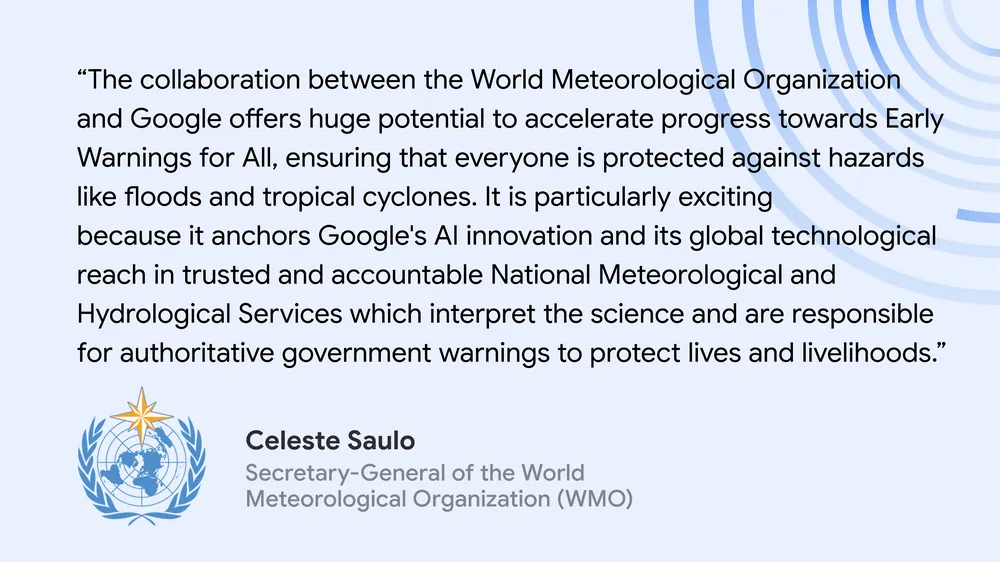
Quote from Celeste Saulo, Secretary-General of the World Meterological Organization (WMO)

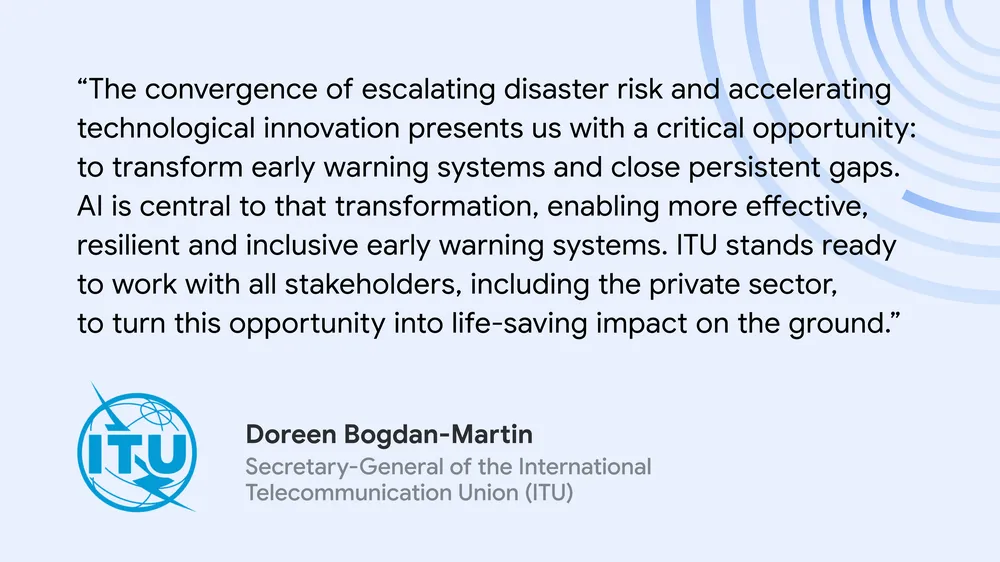
Quote from Doreen Bogdan-Martin, Secretary-General of the International Telecommunication Union (TMU): "The convergence of escalating disaster risk and accelerating technological innovation presents us with a critical opportunity: to transform early warning systems and close persistent gaps. AI is central to that transformation, enabling more effective, resilient and inclusive early warning systems. ITU stands ready to work with all stakeholders, including the private sector, to turn this opportunity into life-saving impact on the ground."

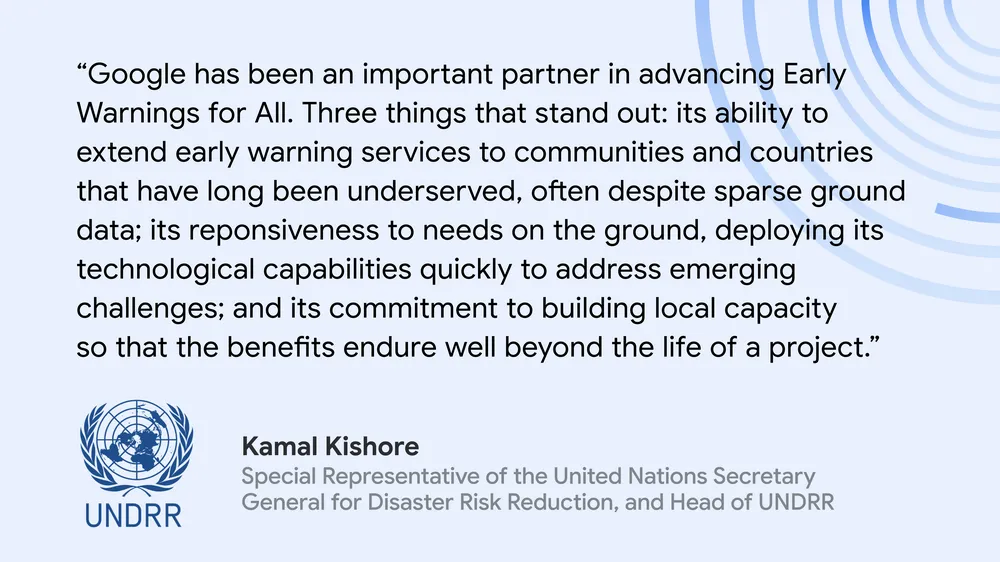
Quote from Kamal Kishore, Special Representative of the United Nations Secretary General for Disaster Risk Reduction, and head of UNDRR: "Google has been an important partner in advancing Early Warnings for All. Three things that stand out: its ability to extend early warning services to communities and countries that have long been underserved, often despite sparse ground data; its reponsiveness to needs on the ground, deploying its technological capabilities quickly to address emerging challenges; and its commitment to building local capacity so that the benefits endure well beyond the life of a project."

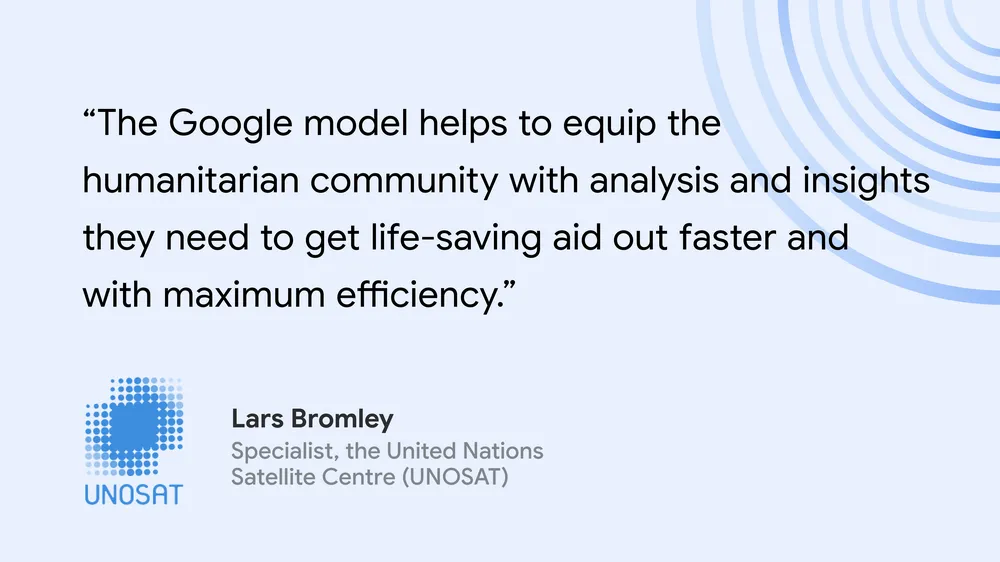
Quote from Lars Bromley, Specialist, the United Nations Satellite Centre (UNOSAT): "The Google model helps to equip the humanitarian community with analysis and insights they need to get life-saving aid out faster and with maximum efficiency"

From forecasting to real-time alerting to post-disaster response, here’s how we’re collaborating with the UN, governments and international organizations on global crisis resilience.

Forecasting and preparing for hazards

Timely nowcasts and forecasts enable governments, humanitarian organizations and communities to take action before disasters strike. During the 2025 hurricane season, the U.S. National Hurricane Center used Google’s WeatherNext model. It predicted Hurricane Melissa’s historic Jamaican landfall five days in advance, enabling the Met Service in Jamaica to notify the public. In Nigeria’s Adamawa state, UN OCHA launched a Floods Anticipatory Action Programme using Google’s river flood forecasts. When forecasts indicate a high risk of significant flooding, it activates a set of early interventions such as shelter preparation. The NGO GiveDirectly employed a similar approach in Nigeria’s Kogi State, using Google’s forecasts to deliver cash transfers before flooding. This enabled families to evacuate safely and purchase equipment like sandbags to protect their property.

Our forecasts are available on Flood Hub, covering 2 billion people across more than 150 countries, in areas at risk for significant flood events. We’re continuously improving forecasting capabilities together with our partners. The World Meteorological Organization (WMO) and national hydrological agencies in Czechia, Nigeria, Uruguay and Vietnam launched a pilot with Google to evaluate how local data affects AI forecasting in regional river basins. We found that incorporating local streamflow data into global AI models significantly improves forecasts in ungauged areas. The results of the study, to be published in the coming weeks, highlight the value of combining global AI models with localized expertise, offering a blueprint for how AI can better support national forecasting efforts.

To further advance research, we recently open-sourced our Groundsource dataset for urban flash floods, and our hydrology modeling framework, helping experts build new approaches while retaining full control of their own local data. We tested the hydrology framework with the Czech Hydrometeorological Institute (CHMI), who developed an adapter enabling them and other hydrological services worldwide to use the model in their standard workflows.

For wildfires, we leverage satellite imagery to track fire boundaries in Search and Maps, with coverage in 34 countries. In collaboration with the Earth Fire Alliance and Muon Space, we developed the purpose-built FireSat constellation, which aims to provide an unprecedented, wildfire dataset and help fire agencies detect wildfires more quickly before they spread, anywhere on earth. Earlier today, three new FireSat satellites launched from Vandenberg Space Force Base in California.

Providing life-saving alerts in times of crisis

In times of crisis, access to reliable, authoritative information is critical for those affected. In 2025 alone, Google helped connect people with crisis information over 10 million times per day, on average.

Among the alerts we distribute are Public Alerts — surfacing content from alerting authorities through Common Alerting Protocol (CAP) feeds. These Public Alerts feature data from authorities in over 90 countries so far, from partners like the US National Weather Service, the UK’s Met Office and Brazil’s Centro Nacional de Gerenciamento de Riscos e Desastres (CENAD). We encourage more nations to publish CAP alert feeds.

When authorities issue these alerts, they can appear across Search, Maps and as Android notifications. This ensures that public safety information, such as severe weather warnings and flood updates, and the practical information people need to stay safe, reaches people quickly and directly.

While warning people effectively about earthquakes remains a critical challenge, we have made progress in alerting those outside the epicenter. When devastating earthquakes hit Venezuela last month, Google’s Android Earthquake alerting system, leveraging a network of Android phones as mini-seismometers, alerted millions of users outside the epicenter enabling them to take cover seconds before the shaking began.

Using satellite imagery to accelerate disaster response

Post-disaster, the core challenge is getting life-saving aid to the people who need it as quickly as possible. AI-powered insights can help governments and organizations respond more efficiently.

Data Insights for Social and Humanitarian Action (DISHA) developed a damage assessment workflow in collaboration with Google, implemented in collaboration with the UN Satellite Centre (UNOSAT). It uses Open Buildings and Building Damage Assessment models to analyze satellite imagery, and was recently enhanced with a new interface, marking a new phase of operational impact. To date, it has been deployed 11 times, supporting the response to disasters like earthquakes, floods and cyclones. It enables high-precision analysis of hundreds of thousands of buildings in very short timeframes, saving UNOSAT specialists weeks of work per activation.

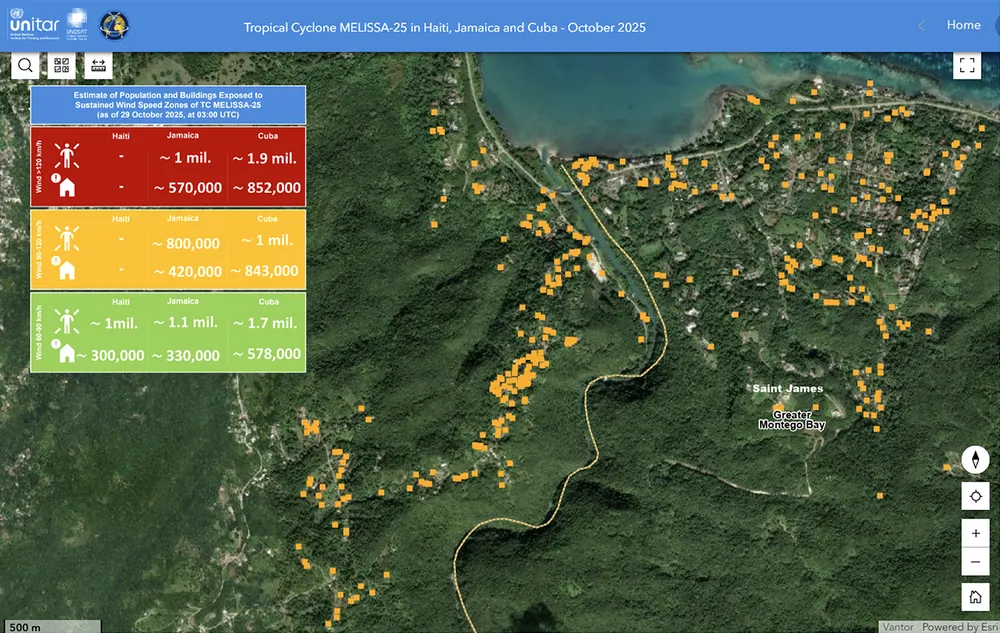
When Hurricane Melissa devastated Jamaica in October 2025, this AI-based analysis assigned preliminary damage scores to over 385,000 buildings to inform recovery efforts. More recently, following the February 2026 floods in Colombia, UNOSAT rapidly assessed damaged infrastructure by cross-referencing AI-derived building maps with radar imagery of the flooding. The analysis informed the response planning of UN humanitarian agencies and the national government.
How governments and organizations are leveraging Google’s AI breakthroughs for crisis resilience

Buildings damaged by the tropical cyclone Melissa identified by the DISHA AI-assisted Damage Assessment solution. Source

While individual models are powerful, the combination of imagery, population and environment insights enables organizations to address more complex, real-world queries. We’ve brought together our climate and geospatial models in the Google Earth AI collection of models and datasets. This provides actionable, planetary intelligence, helping businesses and organizations with disaster response, planetary monitoring and more.

We look forward to continuing to advance AI-based solutions and working with our partners towards our shared, global mission.

Governments and humanitarian organizations are leveraging Google’s AI breakthroughs to shift disaster management from a reactive to a proactive stance across three critical areas: high-precision forecasting, real-time public alerting, and automated post-disaster response. By collaborating through frameworks like the United Nations’ Early Warnings for All initiative, global entities are transforming how communities survive intensifying climate threats. [1, 2]

1. High-Precision Weather and Hazard Forecasting

Organizations use Google’s predictive machine learning models to anticipate natural disasters days in advance, buying critical time for evacuations. [1, 3]
  • Hurricane Forecasting: During the 2025 hurricane season, the U.S. National Hurricane Center used Google’s WeatherNext model to predict Hurricane Melissa’s historic Jamaican landfall five days ahead of time, allowing local meteorological services to sound the alarm early. [3]
  • River and Flash Flooding: Governments use Google’s Flood Hub platform, which covers 2 billion people across 150+ countries, to receive riverine flood forecasts up to 7 days in advance. In Nigeria, UN OCHA integrated these forecasts to launch an anticipatory action programme that sets up shelters before water levels rise. [3, 4, 5, 6]
  • Pre-Disaster Cash Aid: The NGO GiveDirectly used Google’s predictive flood data to trigger automated cash transfers to families in high-risk zones in Nigeria before floods arrived, enabling residents to safely evacuate and purchase property-saving equipment like sandbags. [3]
  • Localized Hydrology Modeling: National hydrological agencies in Czechia, Vietnam, Uruguay, and Nigeria are piloting a framework with Google to blend global AI models with localized streamflow data, vastly improving disaster prediction in regions that traditionally lack physical water gauges. [3]

2. Early Wildfire Detection via Satellite Constellations

Traditional wildfire suppression often fails because fires are spotted too late. AI is closing this window. [3, 7, 8]
  • The FireSat Constellation: In a massive collaborative effort with the Earth Fire Alliance and Muon Space, Google.org provided over $15 million to back FireSat, a custom satellite constellation. Powered by Google AI, it can detect early-stage blazes as small as 5×5 meters (the size of a residential garage) anywhere on Earth within 20 minutes. [3, 7, 9]
  • Real-Time Tracking: Fire protection agencies in 34 countries rely on Google’s automated tracking to map active fire boundaries directly onto Google Search and Maps, helping emergency services guide the public safely away from advancing flames. [3]

3. Accelerated Post-Disaster Humanitarian Aid

When a crisis strikes, finding out which infrastructures are compromised is a highly manual, slow process. AI has optimized this workflow to speed up field logistics. [1, 10, 11, 12, 13]
  • Automated Building Damage Assessment: In partnership with the UN Satellite Centre (UNOSAT), Google combined its Open Buildings dataset (mapping 1.8 billion structures globally) with AI building damage models. [9, 10]
  • Hurricane Recovery: Following Hurricane Melissa, the system instantly generated structural damage scores for more than 385,000 Jamaican buildings, helping aid workers skip manual assessments and immediately prioritize where to deploy survival supplies. [10]
  • Radar and Satellite Sync: After severe flooding in Colombia, UN agencies cross-referenced AI-derived building maps with radar imagery to rapidly assess structural integrity, streamlining emergency humanitarian planning. [10]

4. Institutional Funding for Public Sector Innovation

To ensure that public services can actually deploy these experimental breakthroughs, financial and engineering accelerators have been launched globally. [14]
How governments
  • AI for Government Innovation: Through a $30 million Impact Challenge, Google.org delivers targeted funding (ranging from $500,000 to $3 million) alongside pro bono engineering support to help non-profits, academic institutions, and public entities scale their agentic and generative AI resilience solutions. [14, 15]


Read more

. Big news for Jodhpur! A world-class airport terminal is here

. MCP vs API: Why traditional APIs are failing AI agents

. A new way to connect and earn with gifts

. What’s at the center of Claude’s mind?

. Join video conferences on Google Meet hardware via SIP through Pexip

. Occupancy counting now available for Google Meet on Neat room hardware

. Fill with Gemini in Sheets now available in 11 additional languages

. New calendar sharing permission level and changes to recurring event visibility

. Expanding Managed Agents in Gemini API: background tasks, remote MCP and more

. This expands the FireSat program

. Claude Cowork: coming to mobile and web

. The different levels of how Claude thinks


for more refer Gemini website click here

for more refer Artificial Intelligence  website click here

Category: Artificial Intelligence Tags: AI Gemini, Earth fire alliance address, Facebook en Google, FireSat data, Firesat google, Firesat satellite launched by, Firesat satellite project, flash floods, Gemini, Gemini AI, Gemini Live, Google, Google carbon neutral since 2007, Google com sign in, Google Facebook number, Google Flow AI video, Google Gemini, Google Gemini AI photo, Google India careers, Google India Gemini, Google India office, Google News facebook, Google search image, Google trending facebook, Google’s AI, Google’s AI breakthroughs, governments and organizations, Green and intelligent: the role of AI in the climate transition, Hey Google, hydrology modeling framework, Role of ai in climate change research, U.S. National, UN report, whatsapp, WMO, World Meteorological Organization, YouTube under Google
Post navigation
← The different levels of how Claude thinks A fresh look at Albania, Montenegro, North Macedonia and Serbia on Street View →

Categories


Tax Heal Youtube Channel

https://youtu.be/jlzygPLPNno
July 2026
M T W T F S S
 12345
6789101112
13141516171819
20212223242526
2728293031  
« Jun    

Bank

Dont Forget to Subscribe for Latest Updates and News

Enter your email address:

Delivered by FeedBurner

Recent Posts

  • Gemini 3.5 PRO Is Fable 5 Level.. Google Is Back
  • A fresh look at Albania, Montenegro, North Macedonia and Serbia on Street View
  • How governments and organizations are leveraging Google’s AI breakthroughs for crisis resilience
  • The different levels of how Claude thinks
  • Claude Cowork: coming to mobile and web
  • Three new satellites join the fight against wildfires
  • Expanding Managed Agents in Gemini API: background tasks, remote MCP and more
  • New calendar sharing permission level and changes to recurring event visibility
  • Fill with Gemini in Sheets now available in 11 additional languages
  • Occupancy counting now available for Google Meet on Neat room hardware

TaxHeal

About Taxheal – Daily Tax ,GST & Law Updates Contact Us
  • Useful Links & GST
  • Disclaimer
  • New Releases in Book Store
  • TAXHEAL Mobile App Privacy Policy
  • National Company Law Tribunal
    Bank Concurrent Audit Procedure Manual

    Archives

    • July 2026
    • June 2026
    • May 2026
    • April 2026
    • March 2026
    • February 2026
    • January 2026
    • December 2025
    • November 2025
    • October 2025
    • September 2025
    • August 2025
    • July 2025
    • June 2025
    • May 2025
    • April 2025
    • March 2025
    • February 2025
    • January 2025
    • December 2024
    • November 2024
    • October 2024
    • September 2024
    • August 2024
    • July 2024
    • June 2024
    • May 2024
    • April 2024
    • March 2024
    • February 2024
    • January 2024
    • December 2023
    • November 2023
    • October 2023
    • September 2023
    • August 2023
    • July 2023
    • June 2023
    • May 2023
    • April 2023
    • March 2023
    • February 2023
    • January 2023
    • December 2022
    • November 2022
    • October 2022
    • September 2022
    • August 2022
    • July 2022
    • June 2022
    • May 2022
    • April 2022
    • March 2022
    • February 2022
    • January 2022
    • December 2021
    • November 2021
    • October 2021
    • September 2021
    • August 2021
    • July 2021
    • June 2021
    • May 2021
    • April 2021
    • March 2021
    • February 2021
    • January 2021
    • December 2020
    • November 2020
    • October 2020
    • September 2020
    • August 2020
    • July 2020
    • June 2020
    • May 2020
    • April 2020
    • March 2020
    • February 2020
    • January 2020
    • December 2019
    • November 2019
    • October 2019
    • September 2019
    • August 2019
    • July 2019
    • June 2019
    • May 2019
    • April 2019
    • March 2019
    • February 2019
    • January 2019
    • December 2018
    • November 2018
    • October 2018
    • September 2018
    • August 2018
    • July 2018
    • June 2018
    • May 2018
    • April 2018
    • March 2018
    • February 2018
    • January 2018
    • December 2017
    • November 2017
    • October 2017
    • September 2017
    • August 2017
    • July 2017
    • June 2017
    • May 2017
    • April 2017
    • March 2017
    • February 2017
    • January 2017
    • December 2016
    • November 2016
    • October 2016
    • September 2016
    • August 2016
    • July 2016
    • June 2016
    • May 2016
    • April 2016
    • March 2016
    • February 2016
    • January 2016
    • December 2015
    • November 2015
    • October 2015
    • September 2015
    • August 2015
    • July 2015
    • June 2015
    • April 2015
    • September 2014
    • April 2014
    • June 2013
    • April 2013
    • March 2012
    • August 2011
    • June 2011
    • April 2011
    • January 2011
    • April 2009
    • January 2009
    • February 2005
    • July 2001
    • June 2000
    • January 1998
    • April 1994
    • August 1989
    • June 1989
    • October 1988
    Tax Heal © 2014 - 2026. All rights reserved.
    CA Satbir Singh M-09872233989 Email-Taxheal@gmail.com
    Iconic One Theme | Powered by Wordpress