


Prompts to Learn Anything Faster

✅ *10 Prompts to Learn Anything Faster* 📚⚡
1️⃣ *Teach me like I’m 10*
“I’m trying to learn [topic]. Explain it to me like I’m 10 years old—simple, clear, and fun.”
2️⃣ *Give me the 80/20*
“What’s the 20% of [topic] I should focus on that gives 80% of the value?”
3️⃣ *Break it into steps*
“I want to learn [skill/topic]. Break it down into step-by-step stages I can follow.”
4️⃣ *Explain with examples*
“Teach me [concept], and give 2–3 real-life examples to make it easier to understand.”
5️⃣ *Turn this into a story*
“Help me understand [complex topic] by turning it into a story or analogy I can remember.”
6️⃣ *Quiz me on what I’ve learned*
“I just studied [topic]. Ask me 5 quick questions to test my understanding.”
7️⃣ *Compare concepts*
“I’m confused between [A] and [B]. Show me the key differences with examples.”
8️⃣ *Build a 30-day learning plan*
“I want to master [topic] in 30 days. Create a weekly learning plan with goals.”
9️⃣ *Summarize this like a cheat sheet*
“Give me a one-page cheat sheet for [topic] with definitions, key points, and shortcuts.”
🔟 *Explain how it connects to what I know*
“I already understand [related topic]. Help me connect it with [new topic] so I can learn faster.”
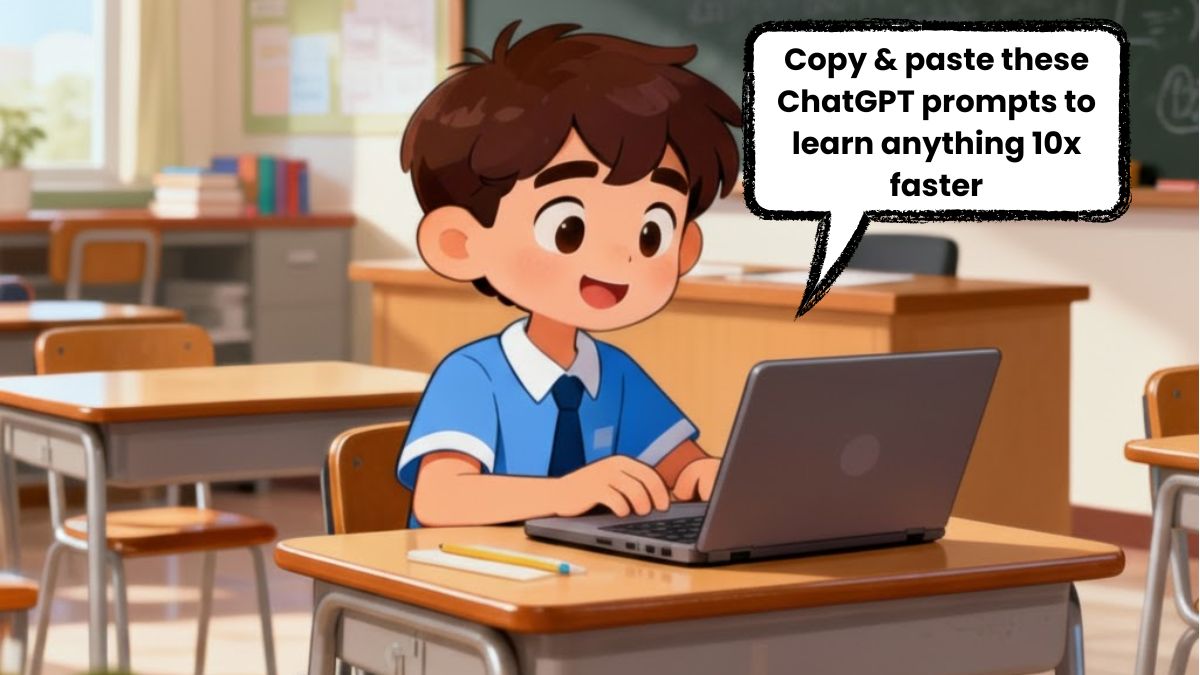
Mastering a new skill or subject isn’t just about the hours you put in; it’s about the quality of the questions you ask. To accelerate your learning, you need to shift from passive consumption to active interrogation.
Here are several high-leverage prompts designed to help you deconstruct, understand, and retain any topic faster.
1. The 80/20 Deconstruction
The Pareto Principle suggests that 20% of the effort often leads to 80% of the results. Use this prompt to find the “minimum effective dose” of a subject.
“I want to learn [Topic]. Can you identify the 20% of concepts, skills, or vocabulary that will provide 80% of the results? Please create a focused learning roadmap based on these core pillars.”
2. The Feynman Technique (Mental Models)
Complexity is often a mask for a lack of understanding. If you can’t explain it simply, you don’t know it well enough.
“Explain [Complex Concept] to me as if I am a ten-year-old. Use simple analogies and avoid jargon. Once you’re done, ask me a question to test if I truly understand the logic behind it.”
3. Mental Model Cross-Pollination
New information sticks best when it “hooks” onto something you already know.
“I already have a strong understanding of [Subject You Know Well]. Can you explain the core principles of [New Subject] by using metaphors and analogies related to [Subject You Know Well]?”
4. The “Pre-Mortem” for Skills
Identify the common pitfalls before you fall into them. This saves weeks of frustration.
“I am a beginner starting to learn [Skill]. What are the most common mistakes beginners make that slow down their progress? How can I design my practice sessions to avoid these ‘learning traps’ from day one?”
5. Socratic Testing
Reading is passive; retrieval is active. Turn your notes into a challenge.
“I am going to paste a text about [Topic] below. Read it, and then ask me five increasingly difficult questions that test my conceptual understanding rather than just my ability to recall facts.”
6. Curated Resource Filtering
In the age of information overload, the bottleneck is often curation, not access.
“I want to become proficient in [Topic]. What are the top 3 books, 2 online courses, and 3 thought leaders I should follow to get a high-signal, low-noise education? Rank them by ‘intensity’ (Beginner to Advanced).”
7. Feedback Loop Optimization
Learning happens in the gap between an attempt and a correction.
“I am working on [Task/Project]. Review my work and provide ‘brutally honest’ feedback. Specifically, point out any logical fallacies, inefficient methods, or areas where my fundamental understanding seems weak.”
Quick Tip for Implementation
When using these prompts, try the “Inverted Learning” approach: spend 10% of your time searching for the best prompts/resources and 90% of your time actually applying the output.
Which specific topic are you looking to tackle first?
 LinkedIn
 - Explain Like I’m 5 (ELI5): “Explain [topic] in simple terms, as if I’m 12 years old.”
- The Analogy Prompt: “Compare [topic] to something familiar or unrelated to make it easier to understand.”
- Core Concepts: “Clarify the most basic concepts of [topic] in plain language.”
 Generative AI
- Socratic Tutor: “Act as a Socratic tutor. Quiz me on [topic], asking one question at a time, and provide hints only when I struggle.”
- The Quizzer: “Generate a 10-question quiz on [topic] with a mix of multiple-choice, true/false, and short-answer questions.”
- The Teacher: “Test my understanding of [topic] by having me explain it back to you in simple terms. Give me feedback on what I missed.”
 YouTube
- 30-Day Master Plan: “Design a fast-track learning path for [skill/subject]. Create a 30-day mastery plan with daily mini-goals, quick wins, and checkpoints.”
- Knowledge Mapper: “Map [topic] into a clear learning structure. Show core ideas, supporting concepts, and practical uses.”
- Chunking: “Break down [complex topic] into manageable chunks.
Read more
60. What does it take to hit the big shot? | Google + NBA
61. The Era of AI Innovation | Where the Internet Lives
62. Why is everyone talking about The Quad God? | Google + Team USA
63. Coding the future | Where the Internet Lives
65. Build Apps for Your Friends (Vibe Coding)
66. Holiday outfit inspiration is everywhere. Find your look with Google.
67. Planning a Quick Getaway? Just Ask Google
68. Lost the plot? Just ask Google to get the tea
69. Upgrade your profile pic with Google Gemini
71. Creating files is now faster and more streamlined with Gemini.
73. Google Wallet adds Aadhaar support in India, expands digital IDs to more countries
76. Show Share & Verify Identity Using Aadhaar App
77. The New Google Photos Feature That Tells You What To Wear
78. The image displays the infotainment screen of a car equipped with Google built-in
for more refer Artificial Intelligence website click here
Your Queries solved
Prompts to learn anything faster reddit,
Prompts to learn anything faster pdf,
5 little known ChatGPT prompts to learn anything faster,
Top 10 ChatGPT prompts to learn anything 10 times faster,
Best prompt to learn anything,
Best AI prompts for learning,
Prompt for learning,
AI prompts to learn,