


Dive deeper into I/O 2026 with NotebookLM

Dive deeper into I/O 2026 with NotebookLM
Google I/O is always jam-packed with announcements, demos and launches — and this year was no exception. Whether you’re looking to dive into the details of a new product or just want to catch up on news you might have missed, you can see it all in the notebook we’ve created using Google NotebookLM.
This notebook has tons of info: YouTube videos of keynote speeches and product demonstrations, blog posts and more.
Here’s how you can use our notebook on web or mobile:
- Listen to an Audio Overview to catch up in less than two minutes.
- Read through a Slide Deck to learn more about the biggest launches.
- Explore our highlights through an Infographic.
- Revisit some of our biggest announcements in a Video Overview.
- Ask your own questions about a new product or launch. (“What are the top updates to Search?”)
(NotebookLM is grounded in provided sources and responses have citations, but remember, like all AI, NotebookLM can generate inaccuracies.)
Still want more? Review the 100 things we announced this year at I/O.
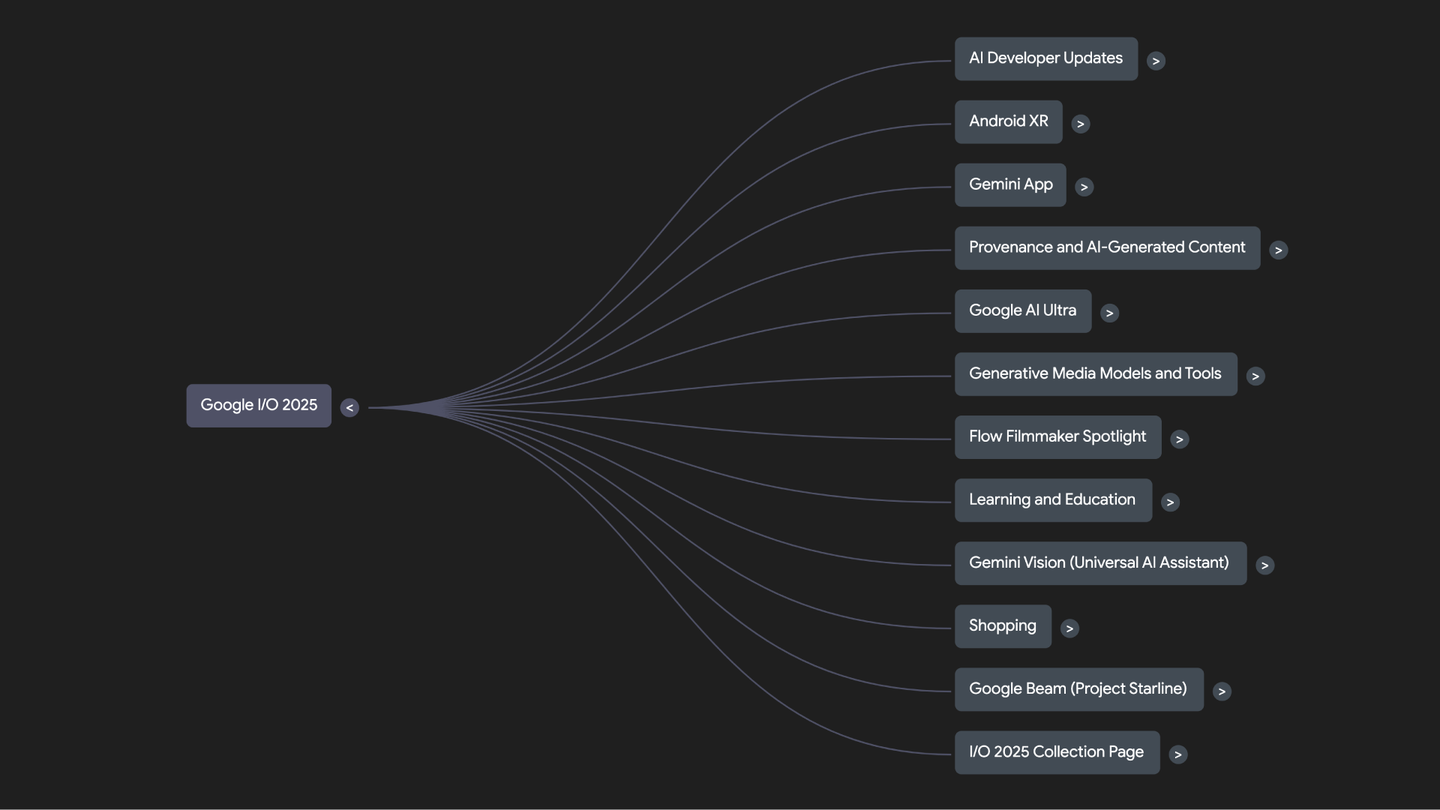
Google I/O 2026 was packed with massive shifts, signaling a transition from AI that simply assists to autonomous agents that act on your behalf. To help everyone digest the sheer volume of announcements, Google launched a dedicated public notebook in NotebookLM loaded with keynotes, product demos, and deep-dive blog posts.
If you want to use NotebookLM to parse the “agentic Gemini era,” here are the core pillars and upgrades from I/O 2026 that you can explore, query, and synthesize.
1. The Core Infrastructure & Frontier Models
The foundational tech powering this new era relies heavily on specialized hardware and lightning-fast models. If you guide NotebookLM to analyze the keynotes, these are the primary technical metrics it will synthesize for you:
-
The Dual-Chip Infrastructure: Google introduced TPU 8t (optimized for large-scale pretraining, pulling together over 1 million TPUs globally via JAX and Pathways) and TPU 8i (engineered specifically to eliminate inference latency).
-
Gemini 3.5 Flash: Built for pure speed and cost-efficiency. It outpaces 3.1 Pro across almost all benchmarks, showing massive leaps in coding and real-world economic task completion (
GDPVal). -
Gemini Omni: A multi-modal model natively capable of generating samples in any output modality from any input, starting with advanced video generation.
2. Consumer AI: The Rise of Autonomous Agents
Instead of waiting for a prompt, Google’s new consumer tools are designed to operate proactively in the background.
-
Gemini Spark: A 24/7 personal agent that can handle ongoing tasks, manage workflows, and operate with minimal oversight.
-
Daily Brief: An out-of-the-box agent in the Gemini app that doesn’t just summarize your morning. It parses your inbox, calendar, and tasks to actively prioritize, organize, and suggest concrete next steps.
-
AI Mode Default in Search: Moving away from static query-and-response, Google Search has pivoted into an ongoing, conversational reasoning agent used by over 2.5 billion monthly active users.
3. Developer Platforms: Antigravity 2.0 & Open Standards
For developers, I/O 2026 centered around Antigravity, Google’s agent-first development platform.
-
Antigravity 2.0 & CLI: Allows developers to spin up complex reasoning subagents in isolated, sandboxed Linux environments with built-in credential masking and hardened Git policies.
-
Managed Agents in the Gemini API: Completely removes infrastructure friction. A single API call provisions an independent agent with a remote sandbox.
-
WebMCP: A new proposed open web standard allowing browser-based AI agents to execute complex client-side tasks with high precision via structured JavaScript tools and HTML forms (experimental origin trials starting in Chrome 149).
How to Query the I/O 2026 Notebook
If you are diving into the official I/O 2026 NotebookLM workspace, you can copy and paste these exact, grounded prompts to extract structured insights:
For a Strategic Product Overview:
"Create a comparison table of the newly announced Gemini 3.5 Flash, Gemini Omni, and Gemini Spark. Include columns for: primary use case, target audience, key technical differentiator, and how it fits into the 'agentic era' theme."
For Developer Tooling Insights:
"Analyze the uploaded developer keynote sources and map out the workflow for building an autonomous agent using Antigravity 2.0. Highlight how subagents, credential masking, and the new WebMCP standard interact."
For a Summary of Consumer Impact:
"Synthesize all announcements related to the Gemini App and Google Search. What are the specific ways 'Daily Brief' and 'AI Mode' change how a consumer interacts with their data on a daily basis compared to previous versions?"
Read more
Use NotebookLM in your Google Workspace Studio flows
NotebookLM introducing Slide Decks
How to Use NotebookLM to Create YouTube Scripts
How to Use NotebookLM for Income Tax Planning
How to Create Smart Notes from Books and Articles Using NotebookLM
Using NotebookLM to Understand Complex Documents Easily
Convert Notes into Easy Summaries with NotebookLM
How to Summarize Long PDFs Using NotebookLM
for more refer Gemini website click here
for more refer Artificial Intelligence website click here