


Merchant Shipping Prevention of Pollution by garbage from Vessels rules 2026 under Merchant Shipping Act 2025

The Gazette of India
CG-DL-E-26052026-272868
EXTRAORDINARY
PART II—Section 3—Sub-section (i)
PUBLISHED BY AUTHORITY
NEW DELHI, WEDNESDAY, MAY 20, 2026/VAISAKHA 30, 1948
MINISTRY OF PORTS, SHIPPING AND WATERWAYS
NOTIFICATION
New Delhi, the 20th May, 2026
G.S.R. 378(E).— In exercise of the powers conferred by sub-section (1) and clauses (d) and (i) of subsection (2) of section 143 read with sub-section (4) of section 133, sub-section (2) of section 135 read with section
136 and sub-section (1) of section 142 of the Merchant Shipping Act, 2025 (24 of 2025), and in supersession of the
Merchant Shipping (Prevention of Pollution by Garbage from Ships) Rules, 2009, except as respects things done or
omitted to be done before such supersession, the Central Government hereby makes the following rules, namely: –
1. Short title and commencement. — (1) These rules may be called the Merchant Shipping (Prevention of
Pollution by Garbage from Vessels) Rules, 2026.
(2) They shall come into force on the date of their publication in the Official Gazette.
2. Definitions. — (1) In these rules, unless the context otherwise requires, —
(a) ―Act‖ means the Merchant Shipping Act, 2025 (24 of 2025);
(b) ―administration‖ means the Director-General for Indian vessels and with respect to a vessel entitled to fly a
flag of another State means the Government of that State;
(c) ―animal carcasses‖ means the bodies of any animals that are carried on board as cargo and that die or are
euthanised during the voyage;
(d) ―Annex‖ means Annex V to the International Convention for the Prevention of Pollution from Ships, 1973, as
modified by the Protocol of 1978 (MARPOL), as amended from time to time;
(e) ―cargo residues‖ means the remnants of any cargo which are not covered by other rules made under the
Merchant Shipping Act, 2025 (24 of 2025) in relation of pollution prevention and which remain on the deck or
in holds following loading or unloading, including loading and unloading excess or spillage, whether in wet or
dry condition or entrained in wash water but does not include cargo dust remaining on the deck after sweeping
or dust on the external surfaces of the vessel;
(f) ―convention‖ means the International Convention for the Prevention of Pollution from Ships, 1973 including
its Protocol of 1978, as amended from time to time;
(g) ―cooking oil‖ means any type of edible oil or animal fat used or intended to be used for the preparation or
cooking of food, but does not include the food itself that is prepared using these oils;
(h) ―domestic wastes‖ means all categories of waste generated within the accommodation spaces of a vessel which
are not regulated under any other rules made under the Merchant Shipping Act, 2025 (24 of 2025) in relating
to pollution prevention, and shall not include grey water;
(i) ―electronic record book‖ means a device or system, approved by the administration, used to electronically
record the required entries for discharges, transfers and other operations as required under the Annex in lieu of
a hard copy record book;
(j) ―en route‖ means that the vessel is underway at sea on a course or courses, including deviation from the
shortest direct route, which as far as practicable for navigational purposes, will cause any discharge to be
spread over as great an area of the sea as is reasonable and practicable;
(k) ―e-waste‖ means electrical and electronic equipment used for the normal operation of the vessel or in the
accommodation spaces, including all components, sub-assemblies and consumables, which are part of the
equipment at the time of discarding, with the presence of material potentially hazardous to human health or to
the environment;
(l) ―fishing gear‖ means any physical device or part thereof or combination of items that may be placed on or in
the water or on the sea-bed with the intended purpose of capturing, or controlling for subsequent capture or
harvesting, marine or fresh water organisms;
(m) ―fixed or floating platforms‖ means fixed or floating structures located at sea which are engaged in the
exploration, exploitation or associated offshore processing of sea-bed mineral resources;
(n) ―food wastes‖ means any spoiled or unspoiled food substances and includes fruits, vegetables, dairy products,
poultry, meat products and food scraps generated aboard vessel;
(o) ―garbage‖ means all kinds of food wastes, domestic wastes and operational wastes, all plastics, cargo residues,
incinerator ashes, cooking oil, fishing gear, and animal carcasses generated during the normal operation of the
vessel and liable to be disposed of continuously or periodically except those substances which are defined or
listed in other rules made under the Merchant Shipping Act, 2025 (24 of 2025) relating to pollution
prevention:
Provided that garbage does not include fresh fish and parts thereof generated as a result of fishing
activities undertaken during the voyage, or as a result of aquaculture activities which involve the transport of
fish including shellfish for placement in the aquaculture facility and the transport of harvested fish including
shellfish from such facilities to shore for processing;
(p) ―HME‖ (harmful to the marine environment) in relation to solid bulk cargoes has the meaning and criteria set
out in the Fourth Schedule;
(q) ―incinerator ashes‖ means ash and clinkers resulting from shipboard incinerators used for the incineration of
garbage;
(r) ―nearest land‖ shall have the same meaning as assigned in the Annex, including the special baseline off the
north-eastern coast of Australia;
(s) ―operational wastes‖ means all solid wastes (including slurries) not covered by other rules made under the
Merchant Shipping Act, 2025 (24 of 2025) relating to pollution prevention that are collected on board during
normal maintenance or operations of a vessel, or used for cargo stowage and handling and it includes cleaning
agents and additives contained in cargo hold and external wash water:
Provided that operational wastes do not include grey water, bilge water, or other similar discharges essential to
the operation of a vessel, taking into account the guidelines developed by the International Maritime
Organization;
(t) ―Organisation‖ means the International Maritime Organization;
(u) ―plastic‖ means a solid material which contains as an essential ingredient one or more high molecular mass
polymers and which is formed (shaped) during either manufacture of the polymer or the fabrication into a
finished product by heat and/or pressure, having material properties ranging from hard and brittle to soft and
elastic and includes all garbage that consists of or includes plastic in any form, including synthetic ropes,
synthetic fishing nets, plastic garbage bags, microplastics, plastic pellets and incinerator ashes from plastic
products;
(v) ―Polar Code‖ means the International Code for vessels operating in polar waters, consisting of an introduction,
Part I-A and Part II-A and Parts I-B and II-B, as adopted by resolutions MSC.385(94) and MEPC.264(68), as
may be amended:
Provided that:
(i) amendments to the environment-related provisions of the introduction and Chapter 5 of Part II-A of the
Polar Code are adopted, brought into force and take effect in accordance with the provisions of Article
16 of the Convention concerning the amendment procedures applicable to an appendix to an annex; and
(ii) amendments to Part II-B of the Polar Code are adopted by the Marine Environment Protection
Committee in accordance with its Rules of Procedure;
(w) ―Polar waters‖ means Arctic waters and/or the Antarctic area.
Explanation: For the purpose of this clause, Arctic waters means those waters which are located north of a
line from the latitude 58º00΄.0 N and longitude 042º00΄.0 W to latitude 64º37΄.0 N, longitude 035º27΄.0 W and
thence by a rhumb line to latitude 67º03΄.9 N, longitude 026º33΄.4 W and thence by a rhumb line to the
latitude 70º49΄.56 N and longitude 008º59΄.61 W (Sørkapp, Jan Mayen) and by the southern shore of Jan
Mayen to 73º31′.6 N and 019º01′.0 E by the Island of Bjørnøya, and thence by a great circle line to the latitude
68º38΄.29 N and longitude 043º23΄.08 E (Cap Kanin Nos) and hence by the northern shore of the Asian
Continent eastward to the Bering Strait and thence from the Bering Strait westward to latitude 60º N as far as
Il’pyrskiy and following the 60th North parallel eastward as far as and including Etolin Strait and thence by the
northern shore of the North American continent as far south as latitude 60º N and thence eastward along
parallel of latitude 60º N, to longitude 056º37΄.1 W and thence to the latitude 58º00΄.0 N, longitude 042º00΄.0
W;
(x) ―Schedule‖ means the Schedules annexed to these rules containing the requirements of Annex V of the
International Convention for the Prevention of Pollution from Ships, 1973, including its Protocol of 1978, as
amended from time to time;
(y) ―special area‖ means a sea area where for recognised technical reasons in relation to its oceanographic and
ecological condition and to the particular character of its traffic the adoption of special mandatory methods for
the prevention of sea pollution by garbage is required and the special areas are the Mediterranean Sea area, the
Baltic Sea area, the Black Sea area, the Red Sea area, the Gulfs area, the North Sea area, the Antarctic area and
the Wider Caribbean Region, which are defined as follows:
(i) the Mediterranean Sea area means the Mediterranean Sea proper including the gulfs and seas therein
with the boundary between the Mediterranean and the Black Sea constituted by the 41º N parallel and
bounded to the west by the Straits of Gibraltar at the meridian 5°36΄ W;
(ii) the Baltic Sea area means the Baltic Sea proper with the Gulf of Bothnia and the Gulf of Finland and the
entrance to the Baltic Sea bounded by the parallel of the Skaw in the Skagerrak at 57º 44.8΄ N;
(iii) the Black Sea area means the Black Sea proper with the boundary between the Mediterranean and the
Black Sea constituted by the parallel 41º N;
(iv) the Red Sea area means the Red Sea proper including the Gulfs of Suez and Aqaba bounded at the south
by the rhumb line between Ras si Ane (12º 28.5΄ N, 43º 19.6΄ E) and Husn Murad (12º 40.4΄ N, 43º
30.2΄ E);
(v) the Gulfs area means the sea area located north-west of the rhumb line between Ras al Hadd (22º 30΄ N,
59º 48΄ E) and Ras al Fasteh (25º 04΄ N, 61º 25΄ E);
(vi) the North Sea area means the North Sea proper including seas therein with the boundary between the
North Sea southwards of latitude 62º N and eastwards of longitude 4º W, the Skagerrak, the southern
limit of which is determined east of the Skaw by latitude 57º 44.8΄ N and the English Channel and its
approaches eastwards of longitude 5º W and northwards of latitude 48º 30΄ N;
(vii)the Antarctic area means the sea area south of latitude 60º S;
(viii) the wider Caribbean Region means the Gulf of Mexico and Caribbean Sea proper including the bays and
seas therein and that portion of the Atlantic Ocean within the boundary constituted by the 30° N parallel
from Florida eastward to 77°30΄ W meridian, thence a rhumb line to the intersection of 20° N parallel
and 59° W meridian, thence a rhumb line to the intersection of 7°20′ N parallel and 50° W meridian,
thence a rhumb line drawn southwesterly to the eastern boundary of French Guiana
(2) Words and expressions used in these rules and not defined but defined in the Act shall have the meanings
respectively assigned to them in the Act.
3. Application. — (1) Unless expressly provided otherwise, the provisions of these rules shall apply in accordance
with sections 131 and 132 of the Act to all vessels and ports.
(2) The vessels and ports to which these rules apply shall comply with the requirements given in the Schedule to
these rules.
4. General prohibition on discharge of garbage into the sea. — (1) Discharge of all garbage and e-waste into the sea is
prohibited, except as provided otherwise in paragraphs 1 to 3 of the First Schedule and rule 5 and section 5.2 of Part
II-A of the Polar Code.
(2) Except as provided in rule 5 of these rules, discharge into the sea of all plastics, including synthetic ropes,
synthetic fishing nets, plastic garbage bags, microplastics, plastic pellets and incinerator ashes from plastic products is prohibited.
5. Exceptions. — (1) The provisions of rule 4 and paragraphs 1 to 3 of the First Schedule and section 5.2 of Chapter
5 of Part II-A of the Polar Code shall not apply to —
(a) the discharge of garbage from a vessel necessary for the purpose of securing the safety of a vessel and those on
board or saving life at sea; or
(b) the accidental loss of garbage resulting from damage to a vessel or its equipment, provided that all reasonable
precautions have been taken before and after the occurrence of the damage, to prevent or minimise the accidental
loss; or
(c) the accidental loss of fishing gear from a vessel provided that all reasonable precautions have been taken to
prevent such loss; or
(d) the discharge of fishing gear from a vessel for the protection of the marine environment or for the safety of that
vessel or its crew.
(2) The en route requirements of paragraphs 1 and 2 of the First Schedule and chapter 5 of Part II-A of the Polar
Code shall not apply to the discharge of food wastes where it is clear the retention on board of these food wastes
presents an imminent health risk to the people on board.
6. Polar waters. — (1) The vessels to which these rules apply while operating in polar waters shall comply with the
environment-related provisions of the introduction and with Chapter 5 of part II-A of the Polar Code, in addition to
any other applicable requirements of these rules.
(2) In applying Chapter 5 of Part II-A of the Polar Code, consideration shall be given to the additional guidance
in Part II-B of the Polar Code.
7. Adequacy of reception facilities. — (1) Every port and terminal in India shall ensure the provision of adequate
facilities for the reception of garbage without causing undue delay to vessels, in accordance with sub-section (1) of
section 142 of the Act.
(2) The Director-General shall notify the Organisation, for transmission to the contracting governments concerned, of all cases where the facilities to be provided under the Annex are alleged to be inadequate.
(3) The fees payable by ports and terminals to the Director-General for audit or inspection of reception facilities and
scrutiny, approval and periodic review of the Port Waste Management Plan (PWMP) shall be Rs. 40,000/-.
8. Control on operational requirements. — (1) Every vessel when in a port or an offshore terminal in India is
subject to inspection by surveyor or an authorised person concerning operational requirements under these rules,
where there are clear grounds for believing that the master or crew are not familiar with essential shipboard
procedures relating to the prevention of pollution by garbage.
(2) In the circumstances specified in sub-rule (1), the surveyor or authorised person shall take such steps to ensure
that the vessel shall not sail until the situation has been brought to order in accordance with the requirements of
these rules.
(3) Nothing in this rule shall be construed to limit the rights and obligations of the Central Government carrying out
control over operational requirements specifically provided for in the Act or rules made thereunder or
Convention.
9. Penalty. — (1) Any contravention of these rules or failure to comply with any requirement thereof shall be liable
to penalties as specified in the Act.
(2) Any person who operates any vessel in contravention of the provisions of these rules, and for which no specific
penalty is provided under sub-section (2) of section 281 of the Act, shall be liable to penalty which may extend to
Rs. 50,000, and if the breach is a continuing one, with further penalty which may extend to Rs. 5,000 for every
day after the first day during which the breach continues.
(3) The imposition of any penalty under this rule shall not absolve the owner or master from the requirement of
rectifying the non-compliance.
FIRST SCHEDULE
[See sub-rule (1) of rule 4 and rule 5]
Prevention of Pollution by Garbage (Annex V, Regs. 3–6)
1. Discharge of garbage outside special areas. — (1) Discharge of the following garbage into the sea outside
special areas shall only be permitted while the vessel is en route and as far as practicable from the nearest land, but in
any case, not less than, —
(a) three nautical miles from the nearest land for food wastes which have been passed through a comminuter or
grinder. Such comminuted or ground food wastes shall be capable of passing through a screen with openings no
greater than 25 mm;
(b) twelve nautical miles from the nearest land for food wastes that have not been treated in accordance with clause
(a);
(c) twelve nautical miles from the nearest land for cargo residues that cannot be recovered using commonly available
methods for unloading, subject to compliance with the conditions specified in the Fifth Schedule. These cargo
residues shall not contain any substances classified as harmful to the marine environment, in accordance with the
criteria set out in the Fourth Schedule;
(d) for animal carcasses, discharge shall occur as far from the nearest land as possible, taking into account the
guidelines issued by the Organisation.
(2) Cleaning agents or additives contained in cargo hold, deck and external surfaces wash water may be discharged
into the sea, provided that such discharge complies with the conditions specified in the Fifth Schedule, and these
substances must not be harmful to the marine environment, taking into account guidelines issued by the
Organisation.
(3) Solid bulk cargoes as defined in regulation VI/1-1.2 of the International Convention for the Safety of Life at Sea
(SOLAS), 1974, as amended, other than grain, shall be classified in accordance with the Fourth Schedule, and
declared by the shipper as to whether or not they are harmful to the marine environment.
(4) When garbage is mixed with or contaminated by other substances prohibited from discharge or having different
discharge requirements, the more stringent requirements shall apply.
2. Discharge within special areas. — (1) Discharge of the following garbage into the sea within special areas
shall only be permitted while the vessel is en route and as follows:
(a) Discharge into the sea of food wastes as far as practicable from the nearest land, but not less than twelve
nautical miles from the nearest land or the nearest ice shelf. Food wastes shall be comminuted or ground and
shall be capable of passing through a screen with openings no greater than 25 mm. Food wastes shall not be
contaminated by any other garbage type. Discharge of introduced avian products, including poultry and
poultry parts, is not permitted in the Antarctic area, unless it has been treated to be made sterile.
(b) Discharge of cargo residues that cannot be recovered using commonly available methods for unloading,
where all the following conditions are satisfied, namely: —
(i) Cargo residues contained in hold washing water do not include any substances classified as harmful to
the marine environment according to the criteria set out in the Fourth Schedule;
(ii) Solid bulk cargoes as defined in regulation VI/1-1.2 of the International Convention for the Safety of
Life at Sea (SOLAS), 1974, as amended, other than grain, shall be classified in accordance with the
Fourth Schedule, and declared by the shipper as to whether or not they are harmful to the marine
environment;
(iii)Cleaning agents or additives contained in hold washing water do not include any substances classified as
harmful to the marine environment taking into account guidelines developed by the Organisation;
(iv)Both the port of departure and the next port of destination are within the special area and the vessel will
not transit outside the special area between those ports;
(v) No adequate reception facilities are available at those ports taking into account guidelines developed by
the Organisation; and
(vi)Where the conditions of sub-clauses (i) to (v) above have been fulfilled, discharge of cargo hold washing
water containing residues shall be made as far as practicable from the nearest land or the nearest ice shelf
and not less than twelve nautical miles from the nearest land or the nearest ice shelf.
(2) Cleaning agents or additives contained in deck and external surfaces wash water may be discharged into the sea,
but only if these substances are not harmful to the marine environment, taking into account guidelines issued by
the Organisation.
(3) In addition to the provisions of sub-paragraph 1, the following rules shall also apply with respect to the Antarctic
area, namely: –
(a) Each party at whose ports vessels depart en route to or arrive from the Antarctic area undertakes to ensure
that as soon as practicable adequate facilities are provided for the reception of all garbage from all vessels,
without causing undue delay, and according to the needs of the vessels using them.
(b) Each party shall ensure that all vessels entitled to fly its flag, before entering the Antarctic area, have
sufficient capacity on board for the retention of all garbage, while operating in the area and have concluded
arrangements to discharge such garbage at a reception facility after leaving the area.
(4) When garbage is mixed with or contaminated by other substances prohibited from discharge or having different
discharge requirements, the more stringent requirements covered by other rules made under the Merchant
Shipping Act, 2025 (24 of 2025) shall apply.
3. Special requirements for discharge of garbage from fixed or floating platforms. — (1) Subject to the
provisions of sub-paragraph (2), the discharge into the sea of any garbage is prohibited from fixed or floating
platforms and from all other vessels when alongside or within 500 m of such platforms.
(2) Food wastes may be discharged into the sea from fixed or floating platforms located more than twelve
nautical miles from the nearest land and from all other vessels when alongside or within 500 m of such platforms, but
only when the wastes have been passed through a comminuter or grinder. Such comminuted or ground food wastes
shall be capable of passing through a screen with openings not greater than 25 mm.
4. Placards. — Every vessel of 12 metres or more in length and fixed or floating platforms, overall shall
display placards as applicable which are specified in the Third Schedule, in the working language of the vessel’s
personnel and also in English for international voyages, notifying the crew and passengers of the garbage discharge
requirements of rule 4 and paragraphs 1, 2 and 3 of this Schedule and section 5.2 of Part II-A of the Polar Code.
5. Garbage Management Plan (GMP). — (1) Every vessel of 100 gross tonnage and above, and every vessel
which is certified to carry fifteen or more persons, and fixed or floating platforms shall carry a garbage management
plan as specified in the Third Schedule, which the crew shall follow.
(2) This plan shall provide written procedures for minimising, collecting, storing, processing and disposing of
garbage, including the use of the equipment on board. It shall also designate the person or persons in charge of
carrying out the plan.
(3) Such a plan shall be based on the guidelines issued by the Organisation and vessel-specific, easy to understand,
and written in the working language of the vessel.
6. Garbage Record Book (GRB) and record-keeping. — (1) Every vessel of 100 gross tonnage and above
and every vessel which is certified to carry fifteen or more persons engaged in voyages to ports or offshore terminals
under the jurisdiction of another party to the convention and every fixed or floating platform shall be provided with a
Garbage Record Book. The Garbage Record Book, whether as a part of the vessel’s official log-book, or as an
electronic record book which shall be approved by the Director-General taking into account the guidelines issued by
the Organisation, shall be in the form specified in the Second Schedule.
(2) Each discharge into the sea or to a reception facility, or a completed incineration, shall be promptly recorded in
the Garbage Record Book and signed for on the date of the discharge or incineration by the officer-in-charge.
Each completed page or group of electronic entries of the Garbage Record Book shall be signed by the master of
the vessel. The entries in the Garbage Record Book shall be in working language of the vessel and English, if
required.
(3) The entry for each discharge into the sea under paragraphs 1 to 3 of this Schedule or section 5.2 of Chapter 5 of
Part II-A of the Polar Code shall include date and time, position of the vessel (latitude and longitude), category of
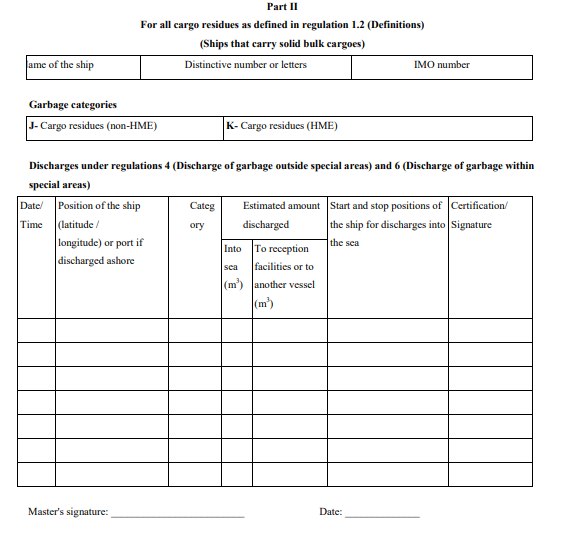
the garbage and the estimated amount (in cubic metres) discharged. For discharge of cargo residues, the
discharge start and stop positions shall be recorded in addition to the foregoing.
(4) The entry for each completed incineration shall include date and time and position of the vessel (latitude and
longitude) at the start and stop of incineration, categories of garbage incinerated and the estimated amount
incinerated for each category in cubic metres.
(5) The entry for each discharge to a port reception facility or another vessel shall include date and time of discharge,
port or facility or name of vessel, categories of garbage discharged, and the estimated amount discharged for
each category in cubic metres.
(6) The Garbage Record Book along with receipts obtained from reception facilities shall be kept on board the vessel
or the fixed or floating platform, and in such a place as to be readily available for inspection at all reasonable
times. This document shall be preserved for a period of at least two years from the date of the last entry made in
it.
(7) In the event of any discharge or accidental loss referred to in rule 5, an entry shall be made in the Garbage
Record Book, or in the case of any vessel of less than 100 gross tonnage, an entry shall be made in official
logbook of the vessel of the date and time of occurrence, port or position of the vessel at time of occurrence
(latitude, longitude and water depth, if known), the reason for the discharge or loss, details of the items
discharged or lost, categories of garbage discharged or lost, estimated amount for each category in cubic metres,
reasonable precautions taken to prevent or minimise such discharge or accidental loss and general remarks.
(8) The Director-General may waive the requirements for Garbage Record Books for —
(a) any vessel engaged on voyages of one hour or less in duration which is certified to carry fifteen or more
persons; or
(b) fixed or floating platforms.
(9) The surveyor or an authorised person may inspect the Garbage Record Books or official logbook of the vessel on
board any vessel to which these rules apply while the vessel is in ports or offshore terminals in India and may
make a copy of any entry in those books, and may require the master of the vessel to certify that the copy is a
true copy of such an entry. Any copy so made, which has been certified by the master of the vessel as a true copy
of an entry in Garbage Record Book of the vessel or official logbook of the vessel, shall be admissible in any
judicial proceedings as evidence of the facts stated in the entry. The inspection of a Garbage Record Book or
official logbook of the vessel and the taking of a certified copy by the surveyor or an authorised person under this
paragraph shall be performed as expeditiously as possible without causing the ship to be unduly delayed.
7. Notifications and reports. — Any accidental loss or discharge of fishing gear, as referred to in clauses (c)
and (d) of sub-rule (1) of rule 5, which poses a hazard to navigation or a threat to the marine environment shall be
reported without delay to the Administration of the State whose flag the vessel is entitled to fly in form specified
under Sixth Schedule. Where such loss or discharge occurs within waters subject to the jurisdiction of a coastal
State, the same shall also be reported to the nearest coastal State authority. Reporting under this paragraph may be
facilitated electronically.
SECOND SCHEDULE
[See paragraph 6 of the First Schedule]
Form of Garbage Record Book
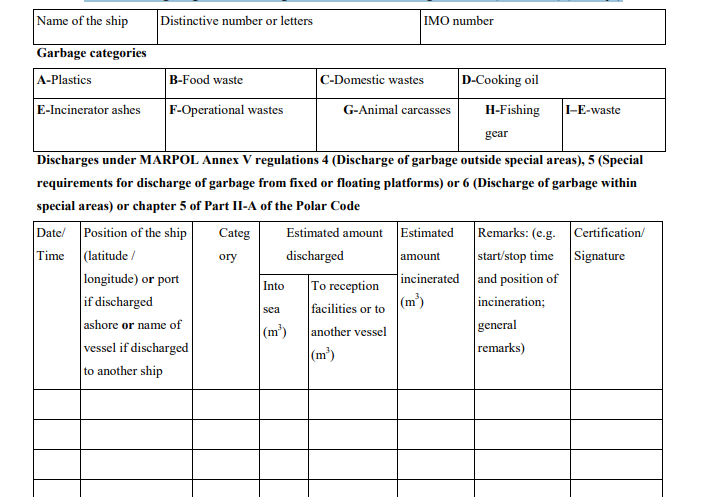
RECORD OF GARBAGE DISCHARGES
Part I – For all garbage other than cargo residues as defined in regulation 1.2 (Definitions) (All ships)
Master’s signature: _________________________ Date: ______________
1. Introduction:
In accordance with regulation 10 of Annex V of the International Convention for the Prevention of Pollution from
Ships, 1973, as modified by the Protocol of 1978 (MARPOL 73/78), a record is to be kept of each discharge operation
or completed incineration. This includes discharges at sea, to reception facilities, or to other vessels as well as the
accidental loss of garbage.
2. Garbage and garbage management:
Garbage means all kinds of food wastes, domestic wastes and operational wastes, all plastics, cargo residues,
incinerator ashes, cooking oil, fishing gear, and animal carcasses generated during the normal operation of the ship
and liable to be disposed of continuously or periodically, except those substances which are defined or listed in other
Annexes to the Convention. Garbage does not include fresh fish and parts thereof generated as a result of fishing
activities undertaken during the voyage, or as a result of aquaculture activities which involve the transport of fish
including shellfish for placement in the aquaculture facility and the transport of harvested fish including shellfish
from such facilities to shore for processing.
The guidelines for the Implementation of Annex V of MARPOL 73/78, as amended by resolutions, shall also be
referred to for relevant information.
3. Description of the garbage:
Garbage is to be grouped into categories for the purposes of recording in parts I and II of the Garbage Record Book
(or ship’s official log-book) as follows:
Part I
A. Plastics;
B. Food wastes;
C. Domestic wastes;
D. Cooking oil;
E. Incinerator ashes;
F. Operational wastes;
G. Animal carcasses;
H. Fishing gear;
I. E-waste.
Part II
J. Cargo residues (non-HME);
K. Cargo residues (HME).
4. Entries in the Garbage Record Book:
(1) Entries in the Garbage Record Book shall be made on each of the following occasions:
(a) When garbage is discharged to reception facilities*
ashore or to other ships:
(i) Date and time of discharge;
(ii) Port or facility, or name of vessel;
(iii)Categories of garbage discharged;
(iv) Estimated amount discharged for each category in cubic metres;
(v) Signature of officer in charge of the operation.
(b) When garbage is incinerated:
(i) Date and time of start and stop of incineration;
(ii) Possession of the vessel (latitude and longitude) at the start and stop of incineration;
(iii)Categories of garbage incinerated;
(iv) Estimated amount incinerated in cubic metres;
(v) Signature of the officer in charge of the operation.
(c) When garbage is discharged into the sea in accordance with regulations 4, 5 or 6 of MARPOL Annex V or
chapter 5 of Part II-A of the Polar Code:
(i) Date and time of discharge;
*
Ship’s masters should obtain from the operator of the reception facilities, which includes barges and trucks, a receipt or certificate
specifying the estimated amount of garbage transferred. The receipts or certificates must be kept together with the Garbage Record Book.
(ii) Position of the vessel (latitude and longitude). Note: for cargo residue discharges, include discharge
start and stop positions;
(iii)Category of garbage discharged;
(iv) Estimated amount discharged for each category in cubic metres;
(v) Signature of the officer in charge of the operation.
(d) Accidental or other exceptional discharges or loss of garbage into the sea, including in accordance
with regulation 7 of Annex V of MARPOL:
(i) Date and time of occurrence;
(ii) Port or position of the vessel at time of occurrence;
(iii) Categories of garbage discharged or lost;
(iv) Estimated amount for each category in cubic metres;
(v) The reason for the discharge or loss and general remarks.
(2) Amount of Garbage:
The amount of garbage on board should be estimated in cubic metres, if possible, separately according to category.
The Garbage Record Book contains many references to estimated amount of garbage. It is recognised that the
accuracy of estimating amounts of garbage is left to interpretation. Volume estimates will differ before and after
processing. Some processing procedures may not allow for a usable estimate of volume, e.g., the continuous
processing of food waste. Such factors should be taken into consideration when making and interpreting entries made
in a record.
RECORD OF GARBAGE DISCHARGES
Ship’s name: _______________________
Distinctive No., or letters: _______________________
IMO No.: ____________
Garbage categories:
1. Plastic;
2. Food waste;
3. Domestic wastes (e.g., paper products, rags, glass, metal, bottles, crockery, etc.);
4. Cooking oil;
5. Incinerator ashes;
6. Operational wastes;
7. Cargo residues;
8. Animal Carcass(es);
9. Fishing gear;
THIRD SCHEDULE
[See paragraphs 4 and 5 of the First Schedule]
Model Placard Text and Garbage Management Plan (Content)
1. Model Placard (indicative text). —
(1) Sample placard targeting crew and shipboard operations
DISCHARGE OF ALL GARBAGE INTO THE SEA IS PROHIBITED EXCEPT PROVIDED OTHERWISE
The MARPOL Convention and domestic law prohibit the discharge of most garbage from vessels. Only the
following garbage types are allowed to be discharged under the specified conditions.
Outside special areas designated under MARPOL Annex V and Arctic waters:
Comminuted or ground food wastes (capable of passing through a screen with openings no larger than
25 mm) may be discharged not less than 3 nm from the nearest land.
Other food wastes may be discharged not less than 12 nm from the nearest land.
Cargo residues classified as not harmful to the marine environment may be discharged not less than 12
nm from the nearest land.
Cleaning agents or additives in cargo hold, deck and external surfaces washing water may be
discharged only if they are not harmful to the marine environment.
With the exception of discharging cleaning agents or additives that are not harmful to the marine
environment and are contained in washing water, the vessel must be en route and as far as practicable
from the nearest land.
Within special areas designated under MARPOL Annex V and Arctic waters:
More stringent discharge requirements apply for the discharges of food wastes and cargo residues; and
Consult MARPOL Annex V, chapter 5 of part II-A of the Polar Code and the shipboard garbage
management plan for details.
For all areas of the sea, vessels carrying specialised cargoes such as live animals or solid bulk cargoes should
consult Annex V and the associated Guidelines for the implementation of Annex V.
Discharge of any type of garbage must be entered in the Garbage Record Book.
Violation of these requirements may result in penalties.
(2) Sample placard targeting fixed or floating platforms and vessels operating within 500 m of such platforms
DISCHARGE OF ALL GARBAGE INTO THE SEA IS PROHIBITED EXCEPT PROVIDED
OTHERWISE
The MARPOL Convention and domestic law prohibit the discharge of all garbage into the sea from fixed or
floating platforms and from all other vessels when alongside or within 500 metres of such platforms.
Exception: Comminuted or ground food wastes may be discharged from fixed or floating platforms located
more than 12 nautical miles from the nearest land and from all other vessels when alongside or within 500
metres of such platforms. Comminuted or ground food wastes must be capable of passing through a screen no
larger than 25 millimetres.
Discharge of any type of garbage must be entered in the Garbage Record Book.
Violation of these requirements may result in penalties.
(3) Sample placard targeting passengers
DISCHARGE OF ALL GARBAGE INTO THE SEA IS PROHIBITED EXCEPT PROVIDED
OTHERWISE
The MARPOL Convention and domestic law prohibit the discharge of most forms of garbage from vessels into
the sea.
Violation of these requirements may result in penalties.
All garbage is to be retained on board and placed in the bins provided.
2. Minimum Content of Garbage Management Plan. —
(1) Vessel particulars, organisation and responsible person.
(2) Garbage segregation plan and designated collection points.
(3) Processing and storage: compaction, comminution, grinding, incineration (no plastics), containers and labelling.
(4) Discharge/disposal procedures by category and sea area.
(5) Delivery to reception facilities and record-keeping.
(6) Training and familiarisation, drills, internal checks and audits.
(7) Contingencies for accidental loss, damage, and reporting.
(8) Use of electronic GRB where approved.
[See paragraphs 1 and 2 of the First Schedule]
Criteria for the Classification of Solid Bulk Cargoes as Harmful to the Marine Environment (HME)
For the purpose of this Schedule, cargo residues are considered to be harmful to the marine environment (HME) if
they are residues of solid bulk cargoes which are classified according to the criteria of the United Nations Globally
Harmonized System of Classification and Labelling of Chemicals (GHS) meeting the following parameters1
:
1. Acute Aquatic Toxicity Category 1; and/or
2. Chronic Aquatic Toxicity Category 1 or 2; and/or
3. Carcinogenicity* Category 1A or 1B combined with not being rapidly degradable and having high
bioaccumulation;
4. MutagenicityError! Bookmark not defined. Category 1A or 1B combined with not being rapidly
degradable and having high bioaccumulation;
5. Reproductive ToxicityError! Bookmark not defined. Category 1A or 1B combined with not being rapidly
degradable and having high bioaccumulation;
6. Specific Target Organ Toxicity Repeated ExposureError! Bookmark not defined. Category 1 combined
with not being rapidly degradable and having high bioaccumulation; and/or
7. Solid bulk cargoes containing or consisting of synthetic polymers, rubber, plastics, or plastic feedstock
pellets (this includes materials that are shredded, milled, chopped or macerated or similar materials).
Note: Shipper’s declaration of HME status shall accompany cargo information.
1 The criteria are based on UN GHS. For specific products (e.g. metals and inorganic metal compounds)
guidance available in UN GHS, annexes 9 and 10 is essential for proper interpretation of the criteria and
classification and should be followed.
*
Products that are classified for Carcinogenicity, Mutagenicity, Reproductive Toxicity or Specific Target
Organ Toxicity Repeated Exposure for oral and dermal hazards or without specification of the exposure
route in the hazard statement.
FIFTH SCHEDULE
[See clause (c) of sub-paragraph (1) and sub-paragraph (2) of paragraph 1 of the First Schedule]
Conditions for Discharge of Non-HME Cargo Residues and Hold-Wash Water (outside special areas)
1. Vessel is en route and discharge is made as far as practicable from nearest land.
2. No plastics or other prohibited substances present.
3. Hold-wash water contains no cleaning agents/additives that are harmful to the marine environment.
4. Discharge only when reception facilities are not available or not practicable to use.
5. Entries made in GRB Part II, including start/stop positions for wash-water.
SIXTH SCHEDULE
[See paragraph 7 of the First Schedule]
Reporting Formats
Lost Fishing Gear Report (vessel/fishing vessel particulars; position; description of gear; circumstances; hazard
assessment; actions taken; contact details).
[F. No. SY-19014/198/2025-MG-Part(4)]
MUKESH MANGAL, Addl. Secy
Download PDF click here
Read more
for more refer Gazette website click here
for more refer YouTube Subscribe website click here