


Google Display Ads has a new home in Demand Gen.
Google Display Ads has a new home in Demand Gen.
Ads & Commerce Blog
Breadcrumb
- Products Google Ads & Commerce
May 26, 2026
Google Display Ads has a new home in Demand Gen.
To help advertisers keep pace with evolving consumer behavior, Google Display Ads is transitioning into a more unified environment. You can now manage your Google Display Network (GDN) presence directly through Demand Gen campaigns. Display advertisers can tap into Demand Gen to fuel discovery and action, continuing to reach audiences across 2 million sites, videos and apps on GDN 1 .
Demand Gen drives scalable business growth across YouTube and Google’s most visual surfaces, including Discover, Gmail and Google Maps, with channel controls to adjust for performance needs. Display advertisers can still serve ads exclusively on GDN, while unlocking more streamlined campaign management, the latest features announced at Google Marketing Live, and more upcoming product innovations.
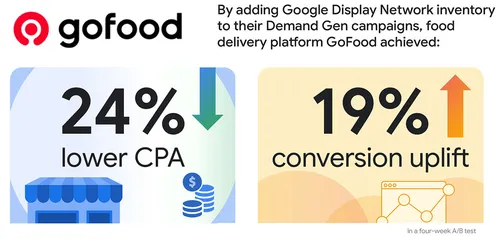
On average, advertisers adding GDN in Demand Gen campaigns see a 9.5% increase in ROI. 2 Food delivery platform GoFood saw a 24% decrease in CPA and 19% higher conversion volume by adding GDN.
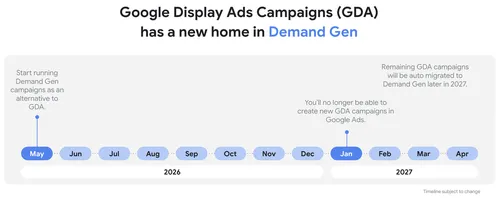
We’ll provide updates and a migration tool to guide your transition, expected to complete by 2027. To prepare, visit the Google Ads Help Center, follow @GoogleAds or check our FAQ page.
Google officially announced that the standalone Display campaign type is being retired, and the Google Display Network (GDN) is transitioning into the Demand Gen campaign environment.
This shift consolidates Google’s visual, discovery-focused ad inventory into a single workflow, following the platform’s broader pattern of streamlining distinct campaign silos into AI-driven environments.
## The Transition Timeline
The migration will be executed in gradual phases rather than an overnight switch:
* **June 2026:** A migration tool will begin rolling out in eligible Google Ads accounts, allowing manual transition of existing standalone Display campaigns into the Demand Gen structure.
* **Late 2026:** Google will stop allowing the creation of new standalone Display campaigns. Existing campaigns will remain editable during this period.
* **Through 2027:** Any remaining eligible standalone Display campaigns will be automatically migrated into Demand Gen by the system.
## What the Shift Means for Campaign Management
While the GDN inventory itself remains available—and advertisers will still have the option to set up campaigns that serve *exclusively* on the Display Network if desired—the structural framework changes significantly:
### 1. New Features and Formats
Moving into Demand Gen gives former Display campaigns access to tools that were previously unavailable in the traditional setup. These include:
* Lookalike audience segments.
* Expanded video ad formats (including YouTube Shorts and In-Stream).
* Carousel ads.
* Generative AI image tools via Asset Studio.
* New bidding options, such as Target CPC (Cost Per Click) and campaign total budgets.
### 2. Operational Impacts and Controls
The consolidation trades granular, manual settings for AI-driven automation.
Marketers who rely heavily on precise controls should prepare for shifts in how campaigns behave:
* **Placement Exclusions:** Because traditional Display often requires extensive curation to weed out low-quality mobile app traffic or irrelevant sites, exporting existing exclusion lists prior to migration is an important safeguard.
* **Audience Expansion:** Demand Gen platforms optimize for discovery and intent generation, meaning the system may expand audience targeting more aggressively than traditional GDN settings.
* **Reporting and Visibility:** Tracking performance shifts at the channel level becomes crucial, especially for checking how budget is allocated between websites, YouTube, and Gmail surfaces.
According to Google’s initial global data, early testers integrating GDN into Demand Gen saw an average 9.5% increase in ROI, though actual account performance remains heavily dependent on the quality of creative assets and backend conversion data tracking.
Read more
. Google Antigravity | I/O 2026 Keynote
. School of Football Training 1. The Basics
. School of Football Can football teach robot to move?
. How Turing unlocks human capability with Google Workspace with Gemini
. Dive deeper into I/O 2026 with NotebookLM
. Puppets x AI Behind the Scenes with Timmy TPU
. New ways to find your favorite sources and original content in AI Search
. Improving AI labels for viewers and creators
. New and improved: Computer-using agents, a new workflows experience, and real-time voice experiences
. Ask Gemini in Google Meet is becoming more easily accessible on web
. Flutter at Google I/O 2026 in 5 minutes
for more refer Gemini website click here
for more refer Artificial Intelligence website click here